Manufacturing
What Is EFCI? Gujarat Subsidy Calculation with Worked Examples
Understand EFCI versus project cost, eligible assets, exclusions and subsidy ceilings through a ₹200 crore Gujarat project example.
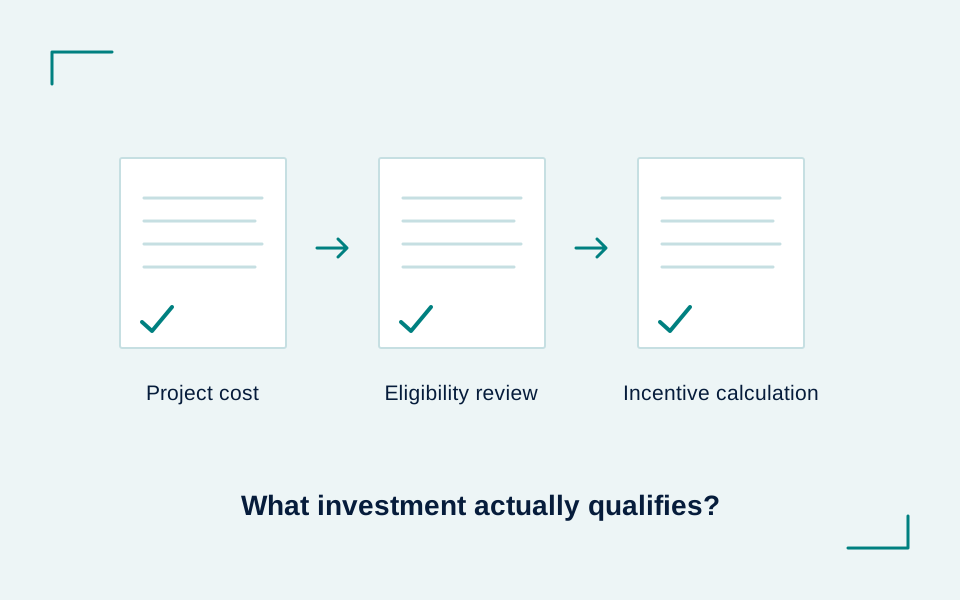
Start with the distinction
EFCI is not the total project budget, the sanctioned loan or every capitalised cost. This guide separates the definition, the calculation and the conditions.
On this page
What is EFCI?
This article explains clauses 1.14–1.17 of Gujarat's 8 September 2026 GR for Large, Mega and Ultra Mega Industries, not a universal definition for every subsidy. The same expenditure can receive different treatment under another scheme. All rupee examples below are hypothetical; no eligibility or sanction is implied.
Project cost, GFCI and EFCI: three different numbers
| Term | What it represents in this context | Why the distinction matters |
|---|---|---|
| Total project cost | The promoter's financing budget, potentially including fixed assets, startup costs and working capital | A bank needs to know how the whole project will be funded |
| GFCI | Gross Fixed Capital Investment of the applied project, as defined in clause 1.14: land, buildings, machinery, utilities, tools, equipment and other required fixed assets acquired and paid for within the eligible period | Relevant to scheme classification and other tests; do not substitute a loan-sanction amount |
| EFCI | Eligible investment accepted under clause 1.15 after applying exclusions, valuation limits and the eligible investment period | The base for the relevant EFCI-linked incentive calculations |
The large-undertaking threshold is a separate test: clause 1.3 requires gross fixed investment in plant and machinery higher than ₹125 crore, with the prescribed filing or permission. ₹125 crore exactly does not meet “higher than”. A ₹200 crore project including expensive land is not necessarily a Large undertaking. Mega and Ultra Mega classification use their own GFCI, sector and employment tests. Compare those classifications.
Source: GR clauses 1.3–1.5 and 1.14–1.17, PDF pp. 2 and 4–6.
Worked example: ₹200 crore project, but ₹175 crore EFCI
- Total project budget
- 200
- Excluded in this example
- − 25
- Illustrative EFCI
- 175
200 − 25 = 175. The assumed eligible assets must satisfy the scheme’s valuation and investment-period conditions. The expenditure breakdown follows below.
Assume the new machinery, building and utilities below satisfy the GR's acquisition, payment, valuation and investment-period conditions. Utilities are separately costed and not already included in machinery.
| Project expenditure | Budget, ₹ crore | Illustrative EFCI, ₹ crore | Reason |
|---|---|---|---|
| Land and land development | 15 | 0 | Excluded by clause 1.16 |
| Eligible new plant and machinery | 140 | 140 | Assumed eligible under clause 1.15(C) |
| Eligible new factory building | 25 | 25 | Assumed accepted under clause 1.15(A) |
| Eligible new utilities | 10 | 10 | Assumed eligible without double counting |
| Working capital | 6 | 0 | Excluded by clause 1.16 |
| Preliminary and pre-operative expenses | 2 | 0 | Excluded by clause 1.16 |
| Capitalised interest | 2 | 0 | Excluded even if capitalised in the accounts |
| Total | 200 | 175 | ₹25 crore does not enter EFCI in this example |
EFCI = ₹140 crore + ₹25 crore + ₹10 crore = ₹175 crore. The financing requirement is still ₹200 crore. An excluded cost does not disappear from the promoter's budget.
How does EFCI change the subsidy calculation?
Continue the example. Assume the undertaking qualifies as Large, General Sector, Category A, and meets the other conditions. Paragraph 4(B) provides capital subsidy of 15% of EFCI over 10 years, a 20% combined ceiling, and a 2% of EFCI annual combined ceiling. Capital subsidy is paid in equal annual instalments under paragraph 6(A), subject to the applicable restrictions.
| Calculation | Illustrative result |
|---|---|
| Capital-subsidy component: 15% × ₹175 crore | ₹26.25 crore over 10 years |
| Equal annual capital instalment before other restrictions | ₹2.625 crore |
| Combined incentive ceiling: 20% × ₹175 crore | ₹35 crore over the incentive period |
| Annual combined ceiling: 2% × ₹175 crore | ₹3.50 crore per year |
₹35 crore is a ceiling, not an automatic grant. Interest and power claims require eligible expenditure and have separate component limits. If otherwise admissible combined claims are ₹4.20 crore in a year, the ₹3.50 crore annual ceiling restricts them by ₹0.70 crore. Paragraph 4(B)(ii) does not permit carry-forward of the amount restricted by that annual ceiling.
Using the entire ₹200 crore budget would incorrectly estimate capital subsidy at ₹30 crore instead of ₹26.25 crore: a ₹3.75 crore overstatement. These are nominal amounts over the scheme period, not today's cash value.
Is the entire building cost eligible?
No blanket answer is appropriate. Clause 1.15(A) distinguishes the new-building valuation rule—actual cost or the relevant R&B Schedule of Rates, whichever is lower—from specified manufacturing-related buildings considered at actual expenditure. It also excludes old-building acquisition and repairs/refurbishment. Buildings on rent or lease are excluded, except the stated GIDC-shed exception.
Source: GR clause 1.15(A), PDF p. 4.
Can infrastructure outside the premises count?
For the specified project-related infrastructure in clause 1.15(D), the GR considers 100% of qualifying cost within the premises and 20% outside. Listed examples include employee housing, a feeder road, dedicated pipelines, certain electricity deposits, communication infrastructure and training facilities.
Source: GR clause 1.15(D), PDF p. 5.
Which common costs are excluded?
Clause 1.16 excludes land and land development; working capital; goodwill; royalty; preliminary/pre-operative expenses; second-hand, leased or rented machinery; capitalised interest; non-captive power-generation plants; rented/leased buildings except the stated GIDC exception; and specified design, consultancy, supervision and inspection charges without technology acquisition. Independent power plants, including renewable energy, are also excluded.
Three nuances matter:
- Land may be excluded from EFCI while a separate stamp-duty benefit exists. Ultra Mega and selected-thrust-sector provisions have their own reimbursement conditions and deadlines. Reimbursed stamp duty/registration charges cannot also be added to EFCI.
- Royalty is excluded from EFCI, but a separate selected-thrust technology-acquisition provision mentions first-two-year royalty. That is paragraph 5(C), not permission to put royalty back into EFCI. Check interaction and non-duplication conditions before combining claims.
- Captive power equipment and power-tariff support are different questions. Qualifying captive generation within the premises can fall within plant and machinery, but power consumed from the unit's own captive plant does not qualify for the power-tariff subsidy under paragraph 6(C).
Sources: GR clauses 1.15(C), 1.16; paragraphs 4(E), 5(A), 5(C), 6(C); PDF pp. 5–6, 10, 12–13 and 15.
Does the sanctioned term loan decide eligible interest subsidy?
No. Clauses 1.17 and 6(B) refer to eligible disbursed term loans and eligible EFCI. The GR excludes NBFC loans from its term-loan definition, even though an NBFC loan may be commercially valid financing. Penal interest and other charges are not eligible interest; default periods also affect entitlement.
The undertaking must bear at least 2% interest. Illustration: On an eligible ₹10 crore loan outstanding for a full year at 8.5%, interest is ₹85 lakh. With no Central interest subsidy and ignoring other ceilings, the minimum-burden condition leaves maximum State support of ₹65 lakh—not ₹70 lakh. Actual disbursement dates, repayments and other caps still need calculation.
Source: GR clause 1.17 and paragraph 6(B), PDF pp. 6 and 15.
Which documents should support an EFCI working?
Build an asset-wise schedule with invoice, supplier, asset description, acquisition date, payment date, bank reference, location, accounting classification, eligible amount, exclusion/restriction and supporting clause. Reconcile it to the fixed-asset register, loan disbursements and the project completion/verification records. This is an editorial working-paper recommendation, not a substitute for the authority's prescribed format.
An invoice date alone is not enough: paragraph 3 refers to assets acquired and paid for from 1 January 2026, within the applicable eligible investment period. Read the registration, PEC/FEC and claim deadlines.
For assistance preparing the investment bridge and financing model, see Project Finance, Subsidy & Grants Advisory and Accounting & Bookkeeping.
Frequently asked questions
Is EFCI the same as the bank's project cost?
No. The bank's funding budget and the scheme's eligible investment base serve different purposes. Reconcile them cost by cost.
Can an MSME use this article's percentages?
Not automatically. This article's calculations use the GR for Large, Mega and Ultra Mega undertakings. A separate MSME scheme must be read on its own terms.
Can I claim subsidy on used machinery?
Clause 1.16 of this GR excludes second-hand machinery. Do not generalise the answer to other schemes without checking them.
Does Category A establish my EFCI?
No. The taluka category helps select the applicable incentive table; asset eligibility determines EFCI. Look up the taluka classification.
Sources and scope
Primary source: Government of Gujarat, Industries & Mines Department, Resolution IMD/WRT/e-file/9/2026/2320/I, dated 8 September 2026, “Scheme for assistance to Large, Mega and Ultra Mega Industries”, supplied PDF 1788927008132.pdf. Page references above refer to its 23-page PDF. Industries Commissionerate official portal is linked for official publications and subsequent instructions; it is not a direct link to the supplied GR.
Source review: 9 September 2026. Examples and working-paper suggestions are our explanations, not illustrations issued by the Government. Detailed implementation instructions, valuation acceptance and project-specific facts can change the result. No subsidy or loan approval is guaranteed.
Source links in this article (1)
References and qualifications remain alongside the relevant explanation above.
This material is general information. Apply it to your business only after checking the relevant facts, source documents and requirements.