Green Energy
Bio-CBG Plant Challenges: Feedstock, Methane Loss, Maintenance and Fertilizer Sale
A practical operating-risk guide for Bio-CBG and Bio-CNG plants covering feedstock procurement, methane loss, repair and maintenance, and the challenge of selling FOM, LFOM and other fertilizer outputs.
On this page
Quick answer
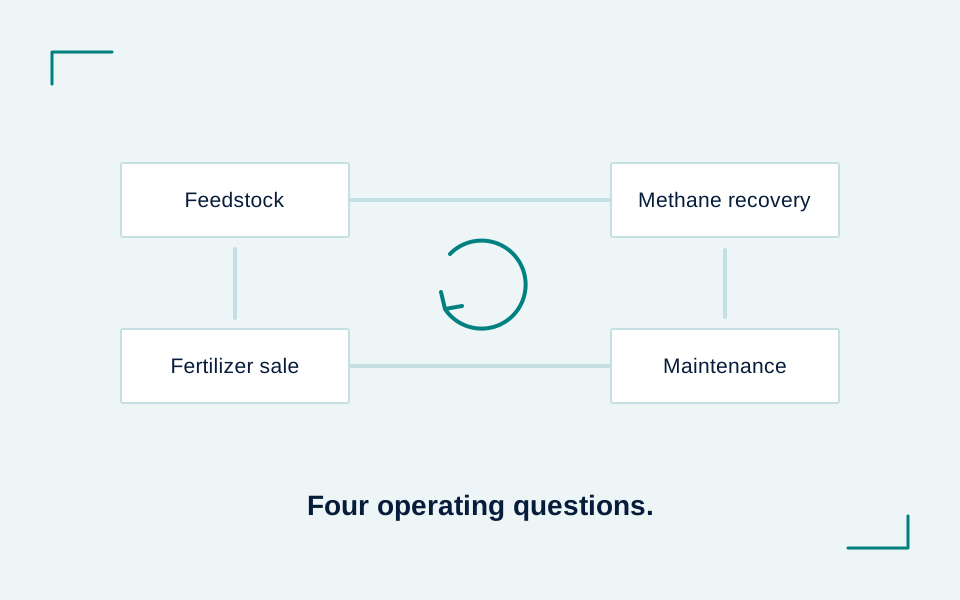
Bio-CBG plants can look attractive in a project report because they convert organic waste into compressed biogas and organic manure. In actual operations, the main bottlenecks are usually not only subsidy, land or plant installation. The recurring challenges are feedstock procurement, methane loss during digestion and gas upgrading, repair and maintenance downtime, and the sale of fermented organic manure, liquid fermented organic manure or other fertilizer outputs.
These four issues decide whether a Bio-CBG plant remains bankable after commissioning.
A promoter should not evaluate a CBG plant only from vendor quotation, subsidy eligibility or gas offtake price. The operating model must be tested every day: how much feedstock will arrive, what quality it will have, how much methane will actually be recovered, how quickly breakdowns can be repaired and whether fertilizer output can be sold at a realizable price.
For broader scheme context, read Bio-CNG and GOBARdhan Benefits in India.
Why operational bottlenecks matter
Government support can improve project viability, but it cannot run the plant.
The PM India release on GOBARdhan states that the National Circular Bioenergy Scheme has a total outlay of INR 23,731 crore and is intended to scale CBG through assured offtake, stable pricing, capital assistance, pipeline infrastructure, credit support and ecosystem development. The same release says CBG plants can use agricultural residue, cattle dung, press mud, municipal organic waste and other biomass resources.
That policy support is important. But at plant level, CBG production still depends on biology, logistics, uptime, gas quality and manure monetization.
In simple terms:
| Area | What can go wrong |
|---|---|
| feedstock | promised quantity does not arrive, quality changes, collection cost rises |
| methane | gas yield is lower than DPR assumption or methane escapes through leaks and methane slip |
| repair and maintenance | agitators, pumps, H2S removal, scrubber, compressor or sensors fail |
| fertilizer | FOM or LFOM output is produced but not sold fast enough or at expected price |
Bottleneck 1. Procurement of feedstock
Feedstock is the fuel of the Bio-CBG plant.
A plant can have the best digester and purification system, but if feedstock is irregular, contaminated or costly, gas production becomes unstable.
Common feedstock problems
- actual feedstock quantity is lower than the DPR assumption
- cattle dung, press mud, napier grass, agri residue or municipal wet waste has seasonal variation
- moisture, total solids and volatile solids differ from design assumptions
- sand, plastic, stones and non-biodegradable material enter the system
- competing buyers increase feedstock price
- transport cost becomes higher than expected
- local suppliers do not honor informal commitments
- storage is insufficient for rainy season or supply disruption
- feedstock source is too far from the plant
Why this damages the plant
Feedstock inconsistency does not only reduce production. It can disturb digester biology.
If the digester receives too much load suddenly, or receives low-quality feedstock, the plant may face low gas generation, foaming, acidity, scum formation, odor complaints, higher chemical use and more downtime.
What promoters should do before project finalization
| Check | Practical action |
|---|---|
| quantity | verify actual daily availability, not only supplier letters |
| quality | test total solids, volatile solids, moisture, contaminants and expected gas yield |
| seasonality | check summer, monsoon, crop-cycle and festival-period variation |
| distance | calculate real delivered cost per tonne at plant gate |
| contract | use written feedstock agreements with price, escalation and quality terms |
| backup | keep alternate feedstock sources mapped |
| storage | plan covered storage, leachate control and odor management |
| accounting | track feedstock cost per kg of CBG produced |
Feedstock should be treated like raw material in a manufacturing business, not like free waste.
For a Gujarat project, the feedstock plan should also connect with location selection, land availability, access road, local permissions and Project Finance assumptions.
Bottleneck 2. Methane loss during the process
Methane loss is both a commercial loss and an environmental problem.
A CBG plant earns revenue from methane recovered and sold. If methane escapes through leakage, poor digestion, gas holder losses, piping leaks, upgrading slip, compressor leakage, open digestate handling or venting, the project loses saleable gas.
Where methane loss can happen
| Stage | Possible loss point |
|---|---|
| digester | poor digestion, overloading, foaming, open handling or gas leakage |
| gas holder | membrane leakage, pressure variation or poor sealing |
| piping | flange leakage, valve leakage or poor installation |
| desulphurization | operational upset, corrosion or bypass leakage |
| upgrading system | methane slip from water scrubbing, membrane, PSA or other purification system |
| compressor and bottling | seal leakage, pressure loss or venting during maintenance |
| digestate handling | open storage or incomplete gas recovery from digestate |
| emergency handling | flaring, venting or shutdown events |
Published research shows why this issue must be taken seriously. A 2022 study on fugitive methane emissions from two agricultural biogas plants found that digestate storage and leakage or venting were major contributors, and that leakage at one facility reduced materially after dome membrane repair. Another multi-country study on biogas plant technologies found that methane slip varies by technology, with much lower median slip for some chemical scrubber systems and higher measured slips for some water-scrubber systems. These are not automatic numbers for Indian projects, but they prove the operating point: methane loss must be measured, not assumed.
Why methane loss damages project economics
A small methane loss can look harmless on paper, but the annual impact can be material.
Methane loss affects:
- CBG sale volume
- power consumption per kg of saleable gas
- carbon and sustainability claims
- safety risk
- odor and complaint risk
- lender confidence in performance numbers
- offtake reliability
How to control methane loss
- install leak detection routines for digester, gas holder, pipes, valves and compressors
- monitor methane percentage before and after upgrading
- track raw biogas volume versus final CBG output
- compare daily gas yield with feedstock input
- define acceptable methane slip with the technology vendor
- maintain H2S control to reduce corrosion and downstream equipment damage
- keep online or periodic gas quality testing
- use planned shutdown SOPs instead of emergency venting wherever possible
- check whether methane-rich off-gas requires treatment, flaring or oxidation depending on design
- cover digestate storage or recover residual gas where technically and commercially justified
A useful MIS is simple: feedstock in, raw biogas generated, methane percentage, CBG sold, rejected gas, downtime hours and reason for loss.
This is where Process Automation, SOP Development and Internal Audit can convert plant data into a management control system.
Bottleneck 3. Repair and maintenance
A Bio-CBG plant is not a one-machine project.
It is a biological process plus mechanical equipment plus gas purification plus compression plus manure handling. Maintenance risk is therefore high if the promoter does not plan spares, service access and responsibility.
Critical equipment requiring maintenance discipline
- feedstock receiving and preprocessing equipment
- slurry pumps
- agitators and mixers
- digesters and heating system where applicable
- gas holder
- H2S removal system
- moisture removal system
- CO2 removal or upgrading unit
- compressors
- cascade filling or pipeline injection equipment
- sensors, flow meters and gas analyzers
- flare system
- manure separator, dryer, filter press or enrichment unit
- electrical panels, SCADA and automation systems
MNRE's Waste to Energy Programme page states that SCADA or remote monitoring is mandated for WTE projects except biomass gasifiers. Even where a particular support window has to be verified, this is a useful operating principle: a serious Bio-CBG project needs real-time plant data, not only manual daily notes.
Common maintenance failures
| Failure | Impact |
|---|---|
| agitator failure | poor digestion, scum, lower gas yield |
| pump choking | feed interruption and downtime |
| H2S system failure | corrosion and gas quality issues |
| sensor failure | wrong operating decisions |
| compressor breakdown | gas generation may continue but sale can stop |
| upgrading membrane or scrubber problem | methane loss or off-spec gas |
| lack of spares | small breakdown becomes long shutdown |
| poor AMC | vendor response delay affects capacity utilization |
Maintenance planning checklist
Before ordering the plant, ask the vendor:
- Which equipment has standby arrangement?
- Which parts are imported and what is delivery time?
- Is remote monitoring included?
- Who will support biology after commissioning?
- What is the guaranteed uptime and how is it measured?
- Is H2S removal included fully or as an add-on?
- Are compressor, gas analyzer and CBG bottling systems covered under AMC?
- What happens if the plant must operate at lower feedstock quantity?
- Can critical components be repaired without full plant shutdown?
- What data will be available for bank, investor or management review?
For structured implementation, promoters should combine Project Finance, SOP Development, Process Automation, and Internal Audit from the beginning.
Bottleneck 4. Fertilizer sale
Many Bio-CBG project reports show revenue from FOM, LFOM or digestate-based fertilizer.
This is valid only if the manure can actually be processed, tested, stored, packed, distributed and sold. Fertilizer sale is often harder than expected because it is a separate business.
The GOBARdhan portal explains that the initiative covers management and conversion of cattle dung and solid waste into compost, fertilizer, biogas and Bio-CNG. Separately, the Department of Fertilizers has stated through PIB that the Market Development Assistance scheme provides INR 1,500 per metric tonne for FOM, LFOM and PROM produced from GOBARdhan and CBG plants. The same PIB release states that 120 CBG/BG plants were registered on iFMS as on 4 March 2026 and that 44 MoUs had been signed for marketing FOM, LFOM and PROM.
This shows that government support exists for the manure side, but it also proves that fertilizer sale needs channel development, not only plant production.
Fertilizer sale challenges
- high moisture content makes transport costly
- odor and storage issues affect market acceptance
- FOM or LFOM quality may vary by feedstock
- farmers may compare price with chemical fertilizers or local compost
- dealer margin and logistics reduce net realization
- packaging cost can be underestimated
- product testing and FCO compliance require discipline
- sales may be seasonal, while manure generation is daily
- credit sales can lock working capital
- local market may not absorb the full quantity
Treat FOM and LFOM as a separate business line
| Area | What to plan |
|---|---|
| quality | lab testing, moisture, nutrient value and contamination control |
| compliance | FCO requirements and relevant registrations where applicable |
| processing | solid-liquid separation, drying, enrichment or granulation as needed |
| packaging | bulk, bagged or tanker model depending on market |
| sales channel | fertilizer companies, dealers, FPOs, cooperatives or direct farmer sales |
| working capital | storage, receivables, packaging and transportation |
| pricing | net realization after dealer margin and logistics |
| demand creation | field demos, farmer meetings and agronomy support |
Do not assume fertilizer income will automatically happen because the plant generates digestate.
Financial model: how these bottlenecks affect viability
Each bottleneck should be converted into numbers.
| Risk | Financial impact |
|---|---|
| 10% less feedstock | lower gas output and lower capacity utilization |
| higher feedstock transport cost | higher variable cost per kg of CBG |
| methane loss | lower saleable CBG without lower fixed cost |
| compressor downtime | lost sale days and possible offtake risk |
| delayed fertilizer sale | working capital blockage and storage cost |
| low FOM or LFOM price | lower non-gas revenue and weaker DSCR |
A bankable DPR should include sensitivity analysis for feedstock cost, gas yield, methane recovery, uptime, CBG sale price, fertilizer realization and subsidy timing.
Use Fractional CFO Services, Accounting & Bookkeeping, and Subsidy and Grants Advisory to make the financial model more realistic.
How P K Patel & Associates can support
We can support Bio-CBG and Bio-CNG promoters at the business, finance and control layer.
Our support can include:
- feedstock procurement risk review
- vendor comparison and due diligence checklist
- project feasibility note
- DPR and CMA preparation
- bank loan file preparation
- subsidy eligibility and documentation review
- financial model with sensitivity analysis
- methane loss and plant MIS dashboard design
- SOPs for feedstock purchase, plant reporting, maintenance and fertilizer sale
- accounting setup for capex, grant, subsidy, CBG sale and fertilizer sale
- monthly MIS for lenders, investors and promoters
We do not guarantee loan sanction, subsidy approval, vendor performance or gas yield. The role is to help promoters make the project more structured, document-ready and bankable.
Practical pre-investment checklist
- Feedstock quantity verified through actual site survey
- Feedstock quality tested for expected gas yield
- Supply agreements drafted with price and quality terms
- Vendor references checked with operating plants
- Methane slip and gas quality guarantee reviewed
- Critical spares and AMC cost included in project cost
- Downtime and maintenance SOP prepared
- FOM and LFOM sale channel validated
- Subsidy assumptions verified from current scheme guidelines
- Loan model tested under conservative capacity utilization
- Accounting and MIS system planned before commissioning
FAQ
What is the biggest challenge in a Bio-CBG plant?
Feedstock is often the biggest challenge because the plant needs consistent quantity and quality every day. Without stable feedstock, gas yield, biology and project cash flow become unstable.
Why does methane loss matter?
Methane loss reduces saleable gas and can also create environmental and safety concerns. It should be monitored across digester, gas holder, pipelines, upgrading, compression and digestate handling systems.
Can repair and maintenance stop the whole plant?
Yes. If critical systems such as pumps, agitators, H2S removal, upgrading unit or compressor fail and there is no standby or quick repair plan, the plant can lose production or sale days.
Is fertilizer sale guaranteed from Bio-CBG plants?
No. FOM and LFOM sale depends on quality, compliance, market acceptance, moisture, packaging, dealer network, transport cost and farmer demand.
Should subsidy be included in project viability?
Yes, but conservatively. Subsidy should be included only after checking current scheme rules, eligibility, timing, documentation and whether the support is sanctioned, reimbursement-based or milestone-based.
This article is a practical educational guide. Technology choice, feedstock, permissions, subsidy and financial viability must be reviewed project-wise before investment.
Source links in this article (1)
References and qualifications remain alongside the relevant explanation above.
This material is general information. Apply it to your business only after checking the relevant facts, source documents and requirements.